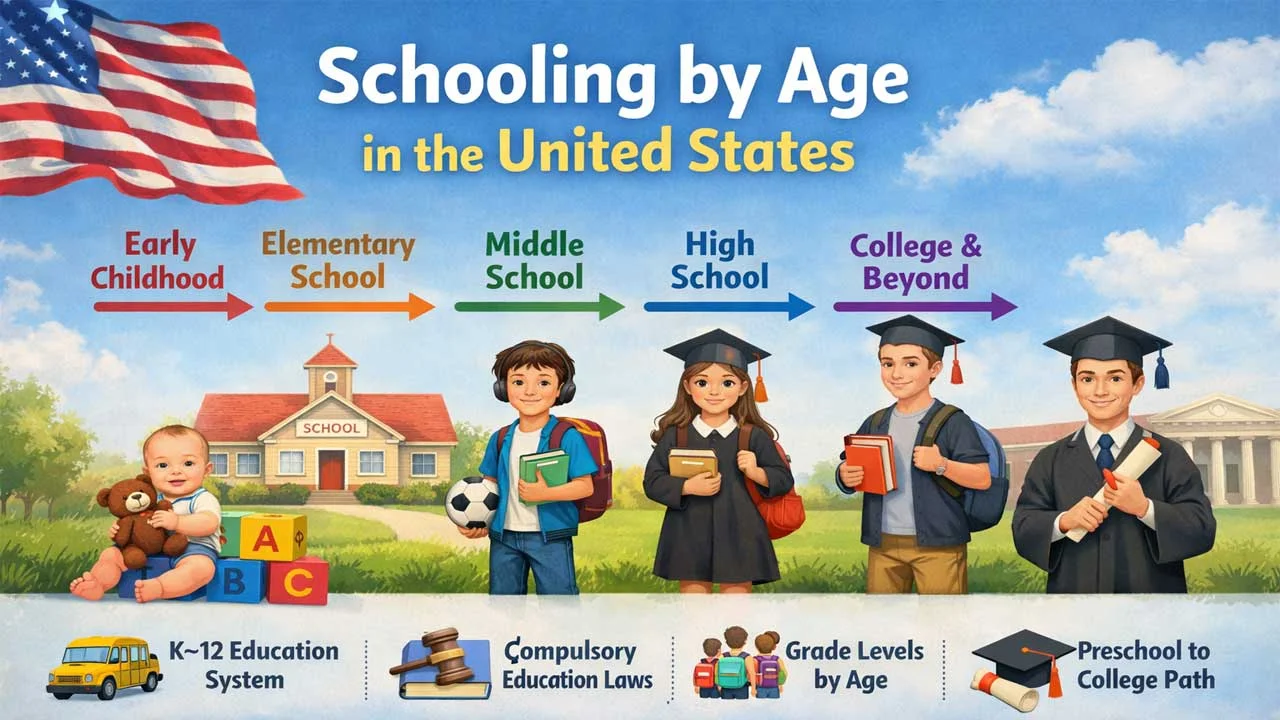
Education plays an important role in American society, and students in the United States have access to many different types of schools and learning programs. From kindergarten and elementary school to universities and professional training, the system offers several routes for students with different interests and goals.
One of the distinctive features of education in the United States is its flexibility. While there are national educational standards and programs, many decisions are made at the state and local levels. This means that school structures, graduation requirements, and curricula can differ depending on where a student lives.
Starting School in America
A child’s formal education commonly begins with kindergarten, although children may attend preschool or other early-learning programs before this stage.
Kindergarten introduces young students to classroom routines and foundational skills. Children begin developing abilities in reading, writing, mathematics, communication, and social interaction.
After kindergarten, students generally continue through elementary school. The elementary years establish the basic academic knowledge that students will use throughout their later education.
Elementary School Years
Elementary school usually covers several grade levels and focuses on core subjects. Students commonly study English language arts, mathematics, science, and social studies.
Schools may also provide physical education, music, art, computer education, and other subjects.
At this stage, teachers often monitor students’ progress closely and help them develop learning habits. Students gradually become more independent as they move through the grades.
Middle School and Junior High
The transition from elementary school to middle school introduces students to a more structured academic environment.
Instead of having one main classroom teacher for most subjects, students generally move between classrooms and work with different teachers. Academic expectations also become more demanding.
Middle school students may study subjects such as mathematics, English, science, history, technology, and foreign languages. They can also participate in sports, clubs, music programs, and other extracurricular activities.
High School Education
High school is usually the final stage of compulsory school education. Students commonly progress from grade nine through grade twelve.
During these years, students complete required courses while often choosing additional subjects that match their interests. Some may take advanced academic classes, while others may explore career and technical education.
High schools can offer courses in areas such as:
- Computer science
- Business
- Engineering
- Art and design
- Healthcare
- Journalism
- Foreign languages
- Skilled trades
Successful completion of high school generally leads to a diploma.
The College Experience
After high school, students who want to continue their education can choose from many types of postsecondary institutions.
Community colleges offer associate degrees, certificates, and career-focused programs. Many students also attend community college before transferring to a four-year institution.
Four-year colleges and universities offer bachelor’s degree programs. Students typically select a major and complete courses within that field alongside general education requirements.
The university experience can also include research projects, internships, student organizations, athletics, and other activities.
Graduate and Professional Education
Education does not have to end with a bachelor’s degree. Students who want advanced knowledge can pursue graduate education.
A master’s degree generally provides deeper study in a particular subject. Doctoral programs are usually focused on advanced research.
The United States also has profes
Leave a Reply