College is about more than memorizing facts, completing assignments, and passing exams. Students must also learn how to analyze information, evaluate evidence, solve problems, and form independent conclusions. These abilities are essential for understanding complex subjects and making informed academic and professional decisions.
Developing critical thinking skills for college students can make a meaningful difference in how you approach lectures, research papers, group projects, examinations, and everyday challenges. Instead of accepting every statement as true, critical thinkers examine the reasons behind an argument, consider different perspectives, and look for reliable evidence before reaching a conclusion.
The good news is that critical thinking is not a skill reserved for naturally analytical people. It can be strengthened through regular practice, thoughtful questioning, academic discussion, and reflection.
In this guide, you will learn what critical thinking means, why it matters in college, and how to develop practical habits that support better learning, stronger academic writing, and more effective problem-solving.
What Are Critical Thinking Skills?
Critical thinking is the ability to examine information carefully, question assumptions, evaluate evidence, and make reasoned judgments. It involves looking beyond the surface of a statement to understand whether its conclusions are logical and adequately supported.
For example, suppose you read an article claiming that students who study late at night always perform better on examinations. Rather than accepting the statement immediately, a critical thinker asks several questions:
- What evidence supports the claim?
- How many students were studied?
- Does the research distinguish between study duration and study quality?
- Were other factors, such as sleep and prior knowledge, considered?
- Do other reliable studies reach similar conclusions?
These questions help you decide whether the claim is convincing, incomplete, or misleading.
Critical thinking does not mean disagreeing with everything you read. It means being willing to question ideas while remaining open to evidence that may support or challenge your existing beliefs.
Key Components of Critical Thinking
Several related abilities contribute to effective critical thinking.
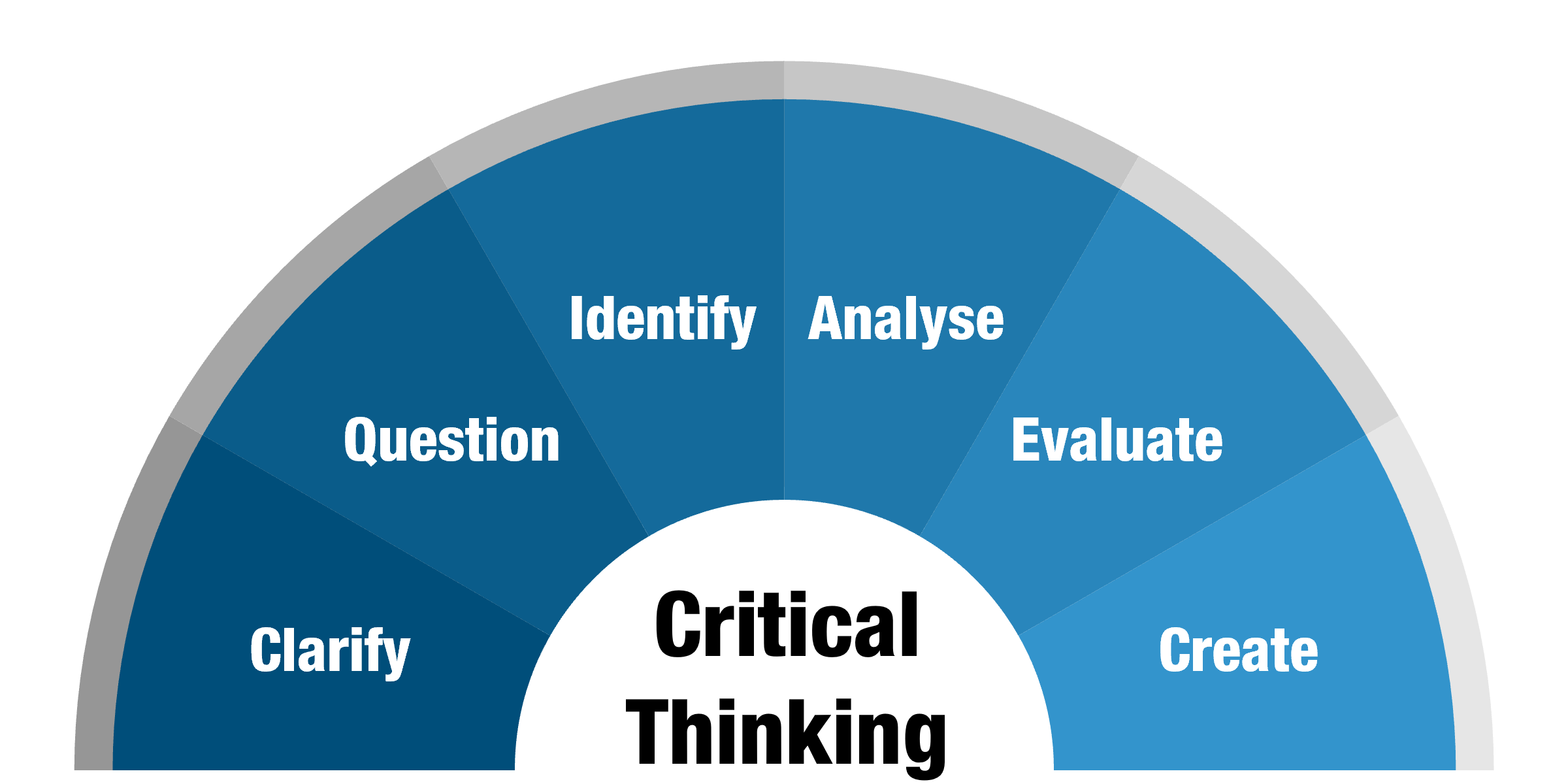
Analysis: Breaking complex information into smaller parts to understand how the ideas connect.
Evaluation: Assessing the quality, credibility, relevance, and strength of evidence.
Interpretation: Understanding what information, data, or observations actually mean.
Inference: Drawing reasonable conclusions from available evidence while recognizing uncertainty.
Problem-solving: Identifying a problem, considering possible solutions, and evaluating their likely consequences.
Reflection: Reviewing your own reasoning to identify mistakes, assumptions, and opportunities to improve.
Open-mindedness: Considering alternative explanations without automatically accepting or rejecting them.
Together, these abilities help students move from simply remembering information to understanding, applying, and evaluating it.
Why Are Critical Thinking Skills Important for College Students?
College courses often require students to work independently, interpret complex material, and develop arguments supported by credible sources. Critical thinking helps students meet these expectations.
1. Improve Academic Performance
Students who analyze course material rather than memorize it alone may develop a deeper understanding of difficult concepts.
For example, a biology student who understands why a scientific process occurs may be better prepared to explain it or apply it to a new problem than a student who only remembers a definition.
Critical thinking also helps students interpret assignment instructions, recognize important concepts, and organize their responses around evidence.
2. Write Stronger Research Papers and Essays
Academic writing requires more than summarizing information from books and websites. Students must evaluate sources, compare viewpoints, and develop an argument that answers the assignment question.
Critical thinking helps you identify the strongest evidence, explain why it matters, and recognize limitations in your own argument.
Instead of simply reporting what different authors say, you can explain where their findings agree, where they differ, and what conclusions the evidence supports.
3. Make Better Decisions
College students regularly make decisions about time management, course selection, finances, study methods, and future careers.
Critical thinking encourages you to compare alternatives, consider consequences, and evaluate information before deciding.
For example, when choosing an elective course, you might compare the workload, relevance to your degree, available resources, and how the course supports your future plans.
4. Evaluate Online Information More Effectively
Students encounter information through social media, websites, videos, online discussions, and AI-generated content. Not all of this information is accurate or trustworthy.
Critical thinking helps you distinguish between evidence-based explanations, unsupported opinions, misleading claims, and information presented without sufficient context.
This is especially important when conducting academic research or sharing information with classmates.
5. Develop Problem-Solving Abilities
Many college assignments involve problems that do not have one obvious answer. Students may need to interpret data, examine competing explanations, or recommend a solution based on limited information.
Critical thinking helps you define the problem, identify relevant evidence, compare possible approaches, and explain why one solution is more appropriate than another.
These habits are also valuable in professional environments where decisions often involve competing priorities and uncertainty.
6. Prepare for Future Career Opportunities
Employers in many fields value people who can evaluate information, communicate clearly, solve problems, and make reasoned decisions.
Whether you plan to work in business, engineering, healthcare, education, technology, finance, or research, critical thinking can help you understand challenges and justify your recommendations.
It does not replace technical knowledge or professional experience. Instead, it helps you apply those abilities more effectively.
10 Practical Ways to Improve Critical Thinking Skills in College
Developing critical thinking takes time and consistent effort. You do not need to change every study habit at once. Start with a few practical strategies and apply them regularly.
1. Ask Questions Instead of Accepting Information Immediately
One of the simplest ways to improve critical thinking is to ask questions whenever you encounter a new idea.
During lectures, readings, or discussions, go beyond asking what a statement means. Ask why it is true, how it was established, and whether another explanation is possible.
Useful questions include:
- What is the main claim?
- What evidence supports it?
- What assumptions does the argument make?
- Is there another way to interpret the information?
- What information is missing?
- What would change my conclusion?
For example, if a lecturer explains that a particular teaching method improves student performance, ask what evidence supports the conclusion and whether the method works equally well for different learners.
You do not need to challenge every statement publicly. You can write questions in your notes and investigate them later.
Practical exercise: Choose one claim from a lecture or reading each day. Write down the claim, its supporting evidence, and one question that could help you evaluate it.
2. Read Academic Sources Critically
College students often need to read textbooks, research papers, reports, and scholarly articles. Reading critically means evaluating how an author develops an argument instead of simply collecting information.
The University of Edinburgh’s academic-skills guidance emphasizes evaluating evidence, considering different viewpoints, and developing your own reasoned position.
When reading a source, examine the following elements:
Author: Does the author have relevant expertise or a credible research background?
Purpose: Is the source intended to inform, persuade, advertise, entertain, or promote a particular position?
Evidence: Are claims supported by research, data, examples, or references?
Currency: Is the information recent enough for your topic?
Limitations: Does the source acknowledge uncertainty, weaknesses, or alternative explanations?
Relevance: Does the information directly help answer your research question?
For instance, a personal blog may provide useful insight into someone’s experience, but it may not be sufficient evidence for a scientific claim. A peer-reviewed study may provide stronger evidence, although its methods, sample size, and limitations still need to be examined.
No source should be accepted automatically simply because it looks professional or uses technical language.
Practical exercise: After reading an academic article, write a short summary of its main claim, the evidence used, and one limitation or unanswered question.
3. Compare Multiple Perspectives
A common mistake is to rely on the first source that supports your existing opinion. Critical thinkers deliberately examine alternative perspectives.
When researching a controversial or complex topic, read sources that approach the question from different angles. Compare their methods, evidence, assumptions, and conclusions.
For example, when studying the advantages of online education, consider research about flexibility and access alongside evidence concerning student engagement, technology access, and independent learning requirements.
You may discover that different conclusions apply to different circumstances.
Comparing perspectives does not mean that every opinion deserves equal weight. Give more consideration to claims supported by reliable evidence and sound reasoning.
Practical exercise: Choose a topic from one of your college courses. Find two credible sources that reach different conclusions and identify the main reasons for their disagreement.
4. Participate in Class Discussions and Debates
Class discussions help you practice explaining ideas, listening to opposing arguments, and responding to questions.
You may discover weaknesses in your reasoning when someone asks for evidence or presents an alternative explanation. Similarly, explaining your position to others can reveal gaps in your own understanding.
To make discussions more productive:
- Prepare one or two questions before class.
- Support your opinions with evidence or logical reasoning.
- Listen carefully before responding.
- Ask classmates to explain their reasoning.
- Distinguish between challenging an idea and criticizing a person.
- Be willing to revise your position when stronger evidence emerges.
You do not have to dominate a discussion to improve your skills. Asking thoughtful questions and listening carefully can be equally valuable.
Practical exercise: During your next seminar or study group, explain one idea from your course and ask another student how they interpret the same evidence.
5. Practice Solving Problems Step by Step
Critical thinking becomes more effective when you use a structured approach to problem-solving.
Instead of jumping immediately to a solution, work through the problem in stages.
Step 1: Define the problem. Identify what needs to be explained, decided, or improved.
Step 2: Gather information. Collect relevant facts, observations, data, and constraints.
Step 3: Identify possible explanations. Consider several reasons the problem may have occurred.
Step 4: Compare solutions. Evaluate the benefits, limitations, costs, and risks of each option.
Step 5: Make a reasoned decision. Select the option best supported by the available evidence.
Step 6: Review the result. Determine whether the solution worked and what you could improve next time.
For example, suppose your group project is falling behind schedule. Rather than assuming one team member is responsible, examine the task distribution, deadlines, communication, and available resources. The real issue may be an unrealistic schedule or unclear responsibilities.
A structured approach helps you avoid premature conclusions and focus on the underlying cause.
6. Improve Your Academic Writing
Writing is an effective way to organize your thoughts and test whether your reasoning is clear.
When preparing an essay, research paper, or report, avoid simply listing facts. Develop a central argument and explain how the evidence supports it.
A useful paragraph structure is:
- Point: State the main idea.
- Evidence: Provide relevant research, data, or an example.
- Analysis: Explain what the evidence means and why it supports your point.
- Link: Connect the discussion to your main argument or the next idea.
For example, instead of writing, “Online learning is flexible because students can access lessons at different times,” you could explain which students may benefit from this flexibility, what conditions make it useful, and what limitations still exist.
Strong academic writing demonstrates the reasoning behind a conclusion, not just the conclusion itself.
After drafting an assignment, review each paragraph and ask whether it contains analysis or mainly describes what other people have said.
Practical exercise: Take one paragraph from an old assignment and highlight the evidence. Then underline the sentences explaining what that evidence means. If the analysis is missing, revise the paragraph.
7. Learn to Recognize Cognitive Biases
Cognitive biases are patterns of thinking that can influence how people interpret information and make decisions.
Everyone is susceptible to bias, including experienced researchers and college students. Recognizing these patterns can help you evaluate claims more carefully.
Some common examples include:
Confirmation bias: Favoring information that supports your existing beliefs while ignoring contradictory evidence.
Availability bias: Judging how common or likely something is based on examples that come easily to mind.
Anchoring bias: Relying too heavily on the first piece of information encountered.
Overconfidence: Being more certain about a conclusion than the available evidence justifies.
Groupthink: Going along with a group’s position without adequately examining alternatives.
Imagine that you believe studying with music always improves concentration. You may remember the occasions when music helped and overlook times when it distracted you.
A more critical approach is to compare your experiences across different tasks and conditions rather than assuming one method works for everyone.
To reduce bias, actively seek counterexamples, separate observations from assumptions, and ask what evidence would cause you to change your mind.
8. Use Evidence to Support Your Opinions
Having an opinion is not the same as having a well-supported argument.
In college assignments, presentations, and discussions, you should be able to explain why you believe a conclusion is justified.
Useful evidence may include peer-reviewed research, official statistics, credible reports, carefully documented observations, or relevant primary sources. The appropriate evidence depends on the subject and the question being investigated.
When evaluating evidence, consider its reliability, relevance, methods, and limitations.
For example, a survey of twenty students may provide useful information about their experiences, but it may not justify a broad claim about all college students. Similarly, a correlation between two variables does not automatically establish that one causes the other.
Distinguishing between what the evidence shows and what you infer from it is an essential critical-thinking habit.
Practical exercise: Before submitting an assignment, identify your three most important claims. Check that each one is supported by appropriate evidence and that your explanation does not go beyond what the evidence justifies.
9. Keep a Reflection Journal
Reflection helps you examine how you reached a conclusion and whether your reasoning could improve.
After completing an assignment, exam, presentation, or difficult decision, take a few minutes to review your process.
Ask yourself:
- What did I understand well?
- Which assumptions influenced my decision?
- What evidence was most useful?
- Did I overlook another perspective?
- Where did I make a mistake?
- What would I do differently next time?
For example, after receiving feedback on a research paper, you might discover that your sources were relevant but your analysis was too descriptive. Your next assignment can focus on explaining how the evidence supports your argument.
A reflection journal does not need to be lengthy. A few honest observations after each major task can help you recognize patterns and improve over time.
10. Challenge Yourself With Real-World Problems
Critical thinking becomes more useful when you apply it beyond textbook exercises.
Choose problems related to your field of study and practice evaluating possible solutions.
A business student might compare the risks of two marketing strategies. An engineering student might investigate why a design failed. A psychology student might examine alternative explanations for a research finding. A computer science student might compare different algorithms for solving the same problem.
Real-world problems often involve incomplete information and competing priorities. Learning to work with uncertainty is therefore an important part of critical thinking.
When possible, discuss your conclusions with classmates, instructors, or professionals who can challenge your assumptions and suggest alternative approaches.
The objective is not always to find one perfect answer. It is to develop a clear, evidence-based explanation for the decision you make.
How to Improve Critical Thinking Through Everyday Study Habits
You do not need a special course or complicated system to practice critical thinking. Small changes to your normal study routine can create regular opportunities to analyze information.
Take Notes in Your Own Words
Copying lecture slides or textbook passages can help you collect information, but it may not show whether you understand the ideas.
Instead, summarize important concepts in your own words. Add questions, connections to earlier topics, and examples that explain how the information works.
Keep track of the original source when recording research findings so you can cite the information accurately in your assignments.
Pause Before Accepting a Conclusion
When you encounter a strong claim, take a moment to consider what would make it convincing.
Ask whether the evidence is relevant, whether alternative explanations exist, and whether the conclusion follows logically from the information presented.
This habit is useful in academic research, online discussions, and everyday decision-making.
Review Feedback Carefully
Instructor feedback can reveal weaknesses in your reasoning that you may not notice yourself.
If a lecturer comments that your essay is too descriptive, for example, identify where you summarize sources without analyzing them. Revise those sections by explaining the significance of the evidence and connecting it to your argument.
Treat feedback as information about how to improve rather than simply as a judgment of your ability.
Explain Difficult Concepts to Someone Else
Explaining a topic to a classmate can reveal gaps in your understanding.
Try to describe the idea without reading directly from your notes. If you cannot explain why something happens or how the evidence supports a conclusion, return to the material and investigate the missing pieces.
This technique also helps you distinguish genuine understanding from memorization.
Common Mistakes That Weaken Critical Thinking
Improving your reasoning involves avoiding habits that can lead to inaccurate or poorly supported conclusions.
Accepting the First Answer
The first explanation you encounter may be correct, but it should not automatically be treated as final.
Check important claims against other credible sources, especially when the topic is complex or the consequences of a mistake are significant.
Confusing Confidence With Accuracy
A person can express an opinion confidently without providing strong evidence. Similarly, a well-supported conclusion may include appropriate uncertainty.
Evaluate the quality of the reasoning rather than judging a claim only by how confidently it is presented.
Ignoring Evidence That Challenges Your Beliefs
Avoid selecting only sources that agree with your existing position. Contradictory evidence can help you identify weaknesses and develop a more balanced conclusion.
You do not have to accept every opposing claim, but you should consider it fairly before deciding whether it is convincing.
Making Conclusions Too Quickly
A conclusion based on limited information may overlook important factors.
Before making a major academic or personal decision, identify what you know, what remains uncertain, and whether additional information could change your judgment.
Treating Every Viewpoint as Equally Reliable
Open-mindedness does not require treating every claim as equally credible.
A personal opinion, an unsupported social media post, a carefully conducted study, and a verified official report do not necessarily provide the same level of evidence. Consider the source, method, relevance, and limitations of each.
Treating Disagreement as a Personal Attack
Critical thinking improves through respectful disagreement. If someone challenges your argument, focus on the evidence and reasoning rather than assuming they are criticizing you personally.
Likewise, when challenging another person’s position, explain your concerns clearly and respectfully.
Critical Thinking Examples for Different College Subjects
Critical thinking looks different across academic disciplines, but the underlying process remains similar: ask questions, examine evidence, compare explanations, and reach a reasoned conclusion.
| Subject | Example of critical thinking |
|---|---|
| Science | Evaluate whether an experiment supports the research hypothesis |
| Business | Compare the costs, risks, and likely outcomes of competing strategies |
| History | Examine primary sources and compare different interpretations of an event |
| Literature | Analyze how a writer’s language, structure, and context shape meaning |
| Mathematics | Explain why a solution works and check whether the result is reasonable |
| Computer science | Compare algorithms and evaluate their performance under different conditions |
| Psychology | Assess research methods and consider alternative explanations for behavior |
| Economics | Examine the assumptions behind a model and evaluate its limitations |
For example, a history student should not rely only on a textbook’s interpretation of an event. Examining primary documents, historical context, and other scholars’ arguments can reveal how interpretations are developed and why they may differ.
Similarly, a mathematics student should understand the logic behind a solution rather than memorizing a procedure without knowing when it applies.
Adapting critical-thinking methods to your subject makes the skills more useful for actual coursework.
A Simple 7-Day Critical Thinking Practice Plan
If you are unsure where to begin, use the following plan to introduce one manageable exercise each day.
| Day | Practice activity | Goal |
|---|---|---|
| Day 1 | Question one claim from a lecture or article | Identify assumptions and evidence |
| Day 2 | Evaluate the credibility of an academic source | Improve source evaluation |
| Day 3 | Compare two perspectives on a course topic | Recognize differences in reasoning |
| Day 4 | Solve a problem using a step-by-step process | Strengthen analytical thinking |
| Day 5 | Revise one paragraph of an essay | Connect evidence to an argument |
| Day 6 | Discuss a difficult question with a classmate | Practice explaining and evaluating ideas |
| Day 7 | Reflect on a recent decision or assignment | Identify strengths and areas for improvement |
At the end of the week, review which activities were most useful and repeat them. As the exercises become easier, use more complex questions and sources.
This plan is a starting point rather than a guarantee of rapid improvement. Critical thinking develops through continued practice across different subjects and situations.
How to Measure Your Critical Thinking Progress
It can be difficult to judge whether your reasoning is improving if you do not review your work.
Instead of relying only on how confident you feel, look for observable changes in your assignments, discussions, and problem-solving process.
You may be making progress when you can:
- Identify the main claim in a complicated text.
- Distinguish evidence from opinion.
- Explain why a source is credible or questionable.
- Recognize assumptions in an argument.
- Compare alternative explanations fairly.
- Support conclusions with relevant evidence.
- Acknowledge limitations and uncertainty.
- Revise your position when stronger evidence becomes available.
- Explain the reasoning behind your decisions clearly.
You can also compare feedback from earlier and later assignments. Look for improvements in argument structure, evidence evaluation, analysis, and the quality of your conclusions.
Ask instructors for specific feedback if you are unsure which skill needs the most attention. Focused practice is often more useful than trying to improve every aspect of reasoning simultaneously.
Frequently Asked Questions About Critical Thinking Skills for College Students
What are the most important critical thinking skills for college students?
Important skills include analysis, evaluation, interpretation, logical reasoning, problem-solving, reflection, and open-mindedness. These abilities help students evaluate academic sources, develop arguments, solve complex problems, and make informed decisions.
How can I improve my critical thinking skills quickly?
Start by asking better questions, evaluating the evidence behind important claims, comparing different perspectives, and explaining your reasoning in writing. You may notice improvements in particular habits with consistent practice, although developing strong critical thinking takes time.
Why is critical thinking important in college?
Critical thinking helps students understand complex concepts, write stronger academic papers, evaluate research, solve problems, and make independent decisions. It also prepares students to assess information and respond thoughtfully to challenges in professional life.
Can critical thinking be learned?
Yes. Critical thinking can be developed through deliberate practice, feedback, discussion, reading, writing, and reflection. Students can strengthen these skills by applying them regularly to academic tasks and real-world problems.
What is the difference between critical thinking and memorization?
Memorization involves retaining and recalling information. Critical thinking involves analyzing that information, evaluating its reliability, understanding relationships, and using evidence to form conclusions. Both can be useful, but college assignments often require students to do more than recall facts.
How does critical thinking improve academic writing?
It helps students develop clear arguments, select credible evidence, compare viewpoints, identify weaknesses in reasoning, and explain why their conclusions are justified. This can make essays and research papers more analytical and persuasive.
How can students practice critical thinking outside the classroom?
Students can evaluate news articles, compare explanations of current issues, analyze personal decisions, discuss complex questions with others, and reflect on the reasoning behind their choices. The key is to examine evidence and consider alternative explanations instead of accepting claims automatically.
Does critical thinking mean questioning everything?
No. Critical thinking means evaluating claims appropriately rather than rejecting them automatically. The amount of scrutiny should depend on the importance of the claim, the quality of available evidence, and the potential consequences of being wrong.
How can group projects improve critical thinking?
Group projects expose students to different perspectives and approaches to solving problems. When team members explain their reasoning, evaluate evidence, and respond respectfully to questions, they can identify weaknesses and develop better-supported conclusions.
How can I use critical thinking when researching online?
Check the author’s expertise, the purpose and date of publication, the evidence provided, and whether other credible sources support the claim. Be cautious of misleading headlines, unsupported statistics, and material that presents opinions as established facts.
Conclusion
Critical thinking is one of the most useful skills college students can develop. It helps you move beyond memorization, understand complex subjects, evaluate information, solve problems, and communicate ideas with greater clarity.
To strengthen your critical thinking skills, make questioning a regular part of your study routine. Read academic sources carefully, compare different perspectives, practice solving problems, support your arguments with evidence, and reflect on feedback from assignments and discussions.
Remember that critical thinking is not about proving other people wrong or doubting every statement. It is about reaching the most reasonable conclusion you can based on the available evidence while remaining open to new information.
Start with one or two strategies, practice them consistently, and apply them across your courses. Over time, these habits can help you become a more independent learner and a more thoughtful decision-maker in college and beyond.
Leave a Reply