Choosing the right research method is one of the most important steps in completing an academic paper, dissertation, thesis, or research project. The method you select influences the type of information you collect, how you analyze your findings, and the conclusions you can reasonably draw.
Two of the most widely used research approaches are qualitative and quantitative research. Although both help researchers investigate questions and develop knowledge, they differ in the types of data they collect and the ways they interpret evidence.
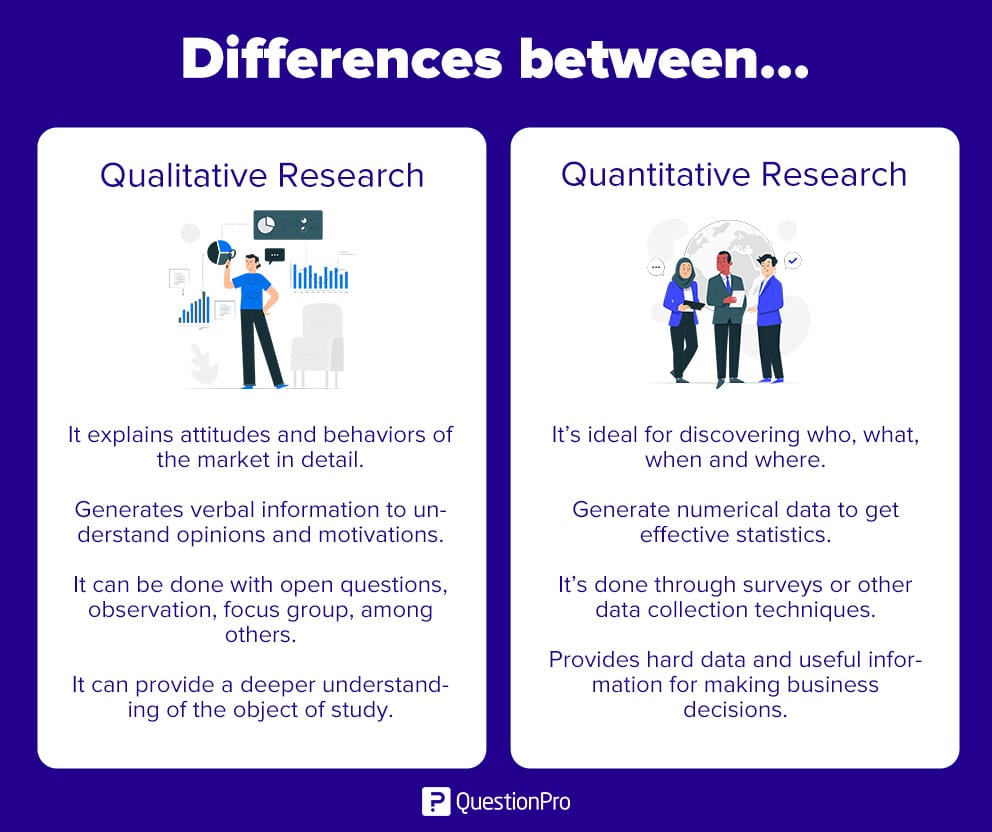
Understanding qualitative vs quantitative research can help students design stronger studies, select appropriate data collection methods, and explain their research decisions clearly. Qualitative research is generally used to explore experiences, perspectives, meanings, and processes. Quantitative research focuses on numerical measurements, patterns, comparisons, and relationships between variables.
Neither approach is automatically better than the other. The right choice depends on your research question, objectives, available resources, and the kind of evidence needed to answer your question.
This guide explains the differences between qualitative and quantitative research, describes common methods, provides practical examples, and shows how to choose the most suitable approach for your academic project.
What Is Qualitative Research?
Qualitative research is an approach that explores how people experience, understand, or interpret a particular situation, behavior, or social phenomenon. It typically uses non-numerical information, including interview transcripts, written responses, observations, documents, and recorded discussions.
The main goal is to develop a detailed understanding of a subject rather than simply measure how frequently something occurs.
For example, a researcher investigating student experiences with online education might interview students about their challenges, motivation, communication with instructors, and feelings about learning remotely.
The researcher would examine the responses to identify recurring themes, differences in experience, and explanations that help answer the research question.
Qualitative research is particularly useful when a topic is complex, when researchers want to explore an issue in depth, or when existing information does not adequately explain people’s experiences.
Common Characteristics of Qualitative Research
Qualitative research often has the following characteristics:
- Detailed information: Researchers collect rich descriptions of experiences, opinions, behaviors, or events.
- Open-ended questions: Participants can explain their views in their own words.
- Contextual understanding: Findings are interpreted in relation to the circumstances in which the information was collected.
- Flexible investigation: Researchers may explore unexpected themes that emerge during data collection.
- Interpretive analysis: Researchers examine meanings, patterns, and relationships within the data.
Qualitative research requires a systematic process. Researchers must explain how participants were selected, how information was collected, how themes were identified, and how interpretations were developed.
Examples of Qualitative Research Questions
Qualitative research is suitable for questions such as:
- How do university students experience their first year of college?
- Why do some learners find online classes difficult to manage?
- How do teachers describe the challenges of inclusive education?
- What factors influence students’ decisions to change their academic major?
- How do employees experience working in a remote environment?
These questions seek explanations, perspectives, or experiences that cannot be fully understood through numerical measurements alone.
What Is Quantitative Research?
Quantitative research collects and analyzes numerical data to measure variables, identify patterns, compare groups, examine relationships, or test hypotheses.
Researchers may gather data through structured surveys, experiments, standardized assessments, physical measurements, or existing statistical records.
For example, a researcher studying online education might survey 500 university students about how many hours they spend studying each week and compare those results with their examination scores.
The researcher could calculate averages, examine correlations, or compare outcomes between groups. The specific analysis would depend on the study design and research question.
Quantitative research is especially useful when researchers need to measure the frequency of an event, estimate the size of a difference, evaluate a relationship, or test a prediction using numerical evidence.
Common Characteristics of Quantitative Research
Quantitative research commonly involves:
- Numerical data: Information is expressed through counts, scores, percentages, measurements, or other numbers.
- Structured procedures: Researchers usually define their measurements and data collection procedures before collecting information.
- Statistical analysis: Numerical data are analyzed using appropriate statistical methods.
- Variable measurement: Researchers examine characteristics that can be measured or categorized.
- Hypothesis testing: Some studies evaluate predictions about differences, relationships, or possible effects.
A well-designed quantitative study requires careful measurement, suitable sampling, appropriate statistical analysis, and transparent reporting of limitations.
Numbers alone do not guarantee reliable findings. The quality of the results depends on how the study was designed and conducted.
Examples of Quantitative Research Questions
Quantitative research is useful for questions such as:
- What percentage of university students attend online classes regularly?
- Is there an association between weekly study time and examination scores?
- How do average test scores differ between two teaching methods?
- How many students change their academic major before graduation?
- Does a particular study program improve assessment performance compared with another approach?
These questions focus on quantities, measurable differences, statistical relationships, or outcomes that can be represented numerically.
Qualitative vs Quantitative Research: Key Differences
The most important difference between qualitative and quantitative research is the kind of evidence each approach uses and the questions it is designed to answer.
| Feature | Qualitative Research | Quantitative Research |
|---|---|---|
| Main purpose | Explore experiences, meanings, and context | Measure variables and identify numerical patterns |
| Data type | Words, descriptions, documents, and observations | Numbers, scores, counts, and measurements |
| Typical questions | How? Why? What is the experience like? | How many? How much? Is there a measurable relationship? |
| Common methods | Interviews, focus groups, open-ended observations | Structured surveys, experiments, standardized measurements |
| Sample approach | Often purposive and focused on information-rich cases | Often designed to support statistical estimates or comparisons |
| Analysis | Coding, interpretation, and theme development | Statistical calculations and comparisons |
| Typical findings | Detailed explanations and contextual insights | Numerical estimates, differences, and relationships |
| Main strength | Depth and understanding of context | Measurement and comparison |
| Main limitation | Findings may not transfer to every setting | Numbers may not explain the full context behind a pattern |
These are general distinctions rather than absolute rules. Some research methods can produce either qualitative or quantitative data depending on how they are designed.
For example, a survey can include numerical rating questions, open-ended questions, or both. An observational study can record the number of times a behavior occurs or describe how that behavior unfolds.
The research question and analysis plan are therefore more important than the name of the data collection method alone.
Qualitative Research Methods
Researchers can use several qualitative methods to investigate experiences, behaviors, and meanings. Each method is suited to particular research objectives.
1. In-Depth Interviews
In-depth interviews involve detailed conversations with participants about their experiences, opinions, decisions, or perspectives.
Researchers usually prepare a set of guiding questions but may ask follow-up questions to explore important points in greater detail.
For example, a researcher investigating university student stress might ask participants to describe their most challenging academic experiences and explain how they manage competing responsibilities.
Interviews can reveal information that a fixed-response questionnaire may overlook. However, conducting, transcribing, and analyzing interviews requires time and careful attention to research ethics.
2. Focus Groups
Focus groups involve guided discussions with a small group of participants who share relevant experiences or characteristics.
A researcher might organize a focus group to understand how students perceive a new university orientation program.
Participants can respond to one another’s comments, introduce new ideas, and explain differences in opinion.
However, group dynamics may influence what people are willing to say. Researchers should avoid assuming that the views expressed by a few participants represent the entire population.
3. Observation
Qualitative observation involves examining behavior, interactions, or activities in a particular setting.
For example, a researcher might observe classroom discussions to understand how students participate in collaborative learning.
The researcher records descriptions of events, interactions, and contextual details rather than focusing exclusively on numerical counts.
Observation can reveal how people behave in real situations, although the presence of an observer and the researcher’s interpretations may influence the findings.
4. Case Studies
A case study examines a particular person, organization, classroom, program, community, or event in depth.
For example, a researcher might study one university’s transition to online learning by examining interviews, course documents, student feedback, and classroom practices.
Case studies can provide detailed explanations of complex situations. They may use qualitative data, quantitative data, or both, depending on the research design.
5. Document and Content Analysis
Researchers can examine written or recorded material to understand how ideas, experiences, or social issues are represented.
Examples include analyzing student reflections, policy documents, interview transcripts, classroom materials, or public communications.
The researcher develops a systematic process for identifying relevant information and interpreting recurring patterns.
Content analysis can be qualitative or quantitative. A qualitative analysis might examine how students describe academic pressure, while a quantitative analysis might count how often particular terms appear in a defined collection of documents.
Quantitative Research Methods
Quantitative research methods help researchers measure variables, compare outcomes, and analyze numerical patterns.
1. Surveys and Questionnaires
Structured surveys collect standardized information from participants using questions with predefined response options.
For example, a researcher investigating study habits might ask students how many hours they study each week, how frequently they attend classes, and what scores they receive on assessments.
Survey results can be summarized using percentages, averages, and other statistical measures.
The usefulness of a survey depends on clear questions, appropriate response options, suitable sampling, and honest reporting of how the data were collected.
2. Experiments
Experiments investigate how changing one factor may affect an outcome under defined conditions.
For example, a researcher might compare two instructional approaches to examine whether students learn a particular skill differently.
A well-designed experiment may assign participants to different conditions, measure outcomes consistently, and control relevant factors where possible.
Random assignment can strengthen the ability to draw causal conclusions, although the appropriate design depends on the setting and research question.
Researchers must also consider ethical requirements, participant safety, and whether the experimental conditions reflect real-world circumstances.
3. Correlational Studies
Correlational research examines whether variables are associated with one another.
For example, a researcher might investigate whether students who spend more time reviewing course material tend to receive higher examination scores.
Statistical analysis can estimate the direction and strength of the relationship.
However, a correlation does not automatically demonstrate that one variable causes the other. Other factors may influence both variables, and the study design must be considered before drawing conclusions.
4. Standardized Assessments
Standardized assessments measure performance using consistent procedures and scoring rules.
Researchers may use examination scores, skill assessments, or validated questionnaires to compare outcomes across individuals or groups.
For example, an education study might compare mathematics assessment results before and after a teaching intervention.
The interpretation of results depends on the quality of the assessment, the study design, and the characteristics of the participants.
5. Analysis of Existing Numerical Data
Researchers do not always need to collect new data. They may analyze existing datasets from educational institutions, government agencies, organizations, or previously conducted studies.
For example, a researcher might examine several years of graduation rates to investigate whether outcomes differ across academic programs.
Secondary data analysis can save time and provide access to large datasets. However, researchers must determine whether the available data measure the variables they need and whether the original collection process introduces limitations.
Qualitative vs Quantitative Research Examples
The difference between these approaches becomes easier to understand when they are applied to the same research topic.
Example 1: Student Satisfaction With Online Education
Research topic: Student satisfaction with online learning.
Qualitative approach: Interview 15 students about their experiences with online classes. Ask open-ended questions about communication, course organization, workload, and access to learning materials. Analyze the responses to identify recurring themes.
Quantitative approach: Survey 300 students using a standardized satisfaction scale. Calculate the average satisfaction score and compare results across relevant groups.
What each approach reveals: The qualitative study can explain why students value certain features or experience particular challenges. The quantitative study can estimate satisfaction levels within the sampled population and compare measured results.
The number of participants in these examples is illustrative, not a universal requirement. Appropriate sample sizes depend on the study design and research objectives.
Example 2: Academic Performance and Study Habits
Research topic: The relationship between study habits and academic performance.
Qualitative approach: Interview students about how they plan their study sessions, manage distractions, and prepare for examinations. Identify common strategies and perceived barriers.
Quantitative approach: Collect data on study hours, attendance, and assessment scores. Use appropriate statistical methods to examine whether these variables are associated.
What each approach reveals: Qualitative findings may help explain how students approach studying and why certain routines feel effective. Quantitative findings may show whether measurable patterns exist between study habits and academic outcomes.
Neither approach alone necessarily proves that a particular study habit causes better grades.
Example 3: Employee Experiences in Remote Work
Research topic: Remote work and employee productivity.
Qualitative approach: Conduct interviews with employees about communication, interruptions, collaboration, and work-life boundaries.
Quantitative approach: Measure defined productivity indicators and compare results across work arrangements, while accounting for relevant differences between employees and roles.
What each approach reveals: Interviews can provide context about employees’ experiences, while numerical measurements can help compare defined outcomes.
Example 4: Teaching Methods in the Classroom
Research topic: The effectiveness of two teaching methods.
Qualitative approach: Observe lessons and interview students about how they understand instructions, participate in activities, and respond to feedback.
Quantitative approach: Compare assessment scores from appropriately designed groups using consistent measurement procedures.
What each approach reveals: Qualitative research can explain how students experience each method. Quantitative research can estimate differences in measured outcomes. A carefully controlled design is needed if the researcher wants to make a strong causal claim about effectiveness.
Advantages of Qualitative Research
Qualitative research offers several benefits when researchers need a detailed understanding of experiences, perspectives, and context.
Provides In-Depth Insights
Open-ended interviews and observations allow participants to explain issues in their own words. This can reveal concerns, motivations, and experiences that predefined response options might miss.
Helps Explore Complex Topics
Some research questions involve identity, culture, relationships, decisions, or personal experiences. These subjects may require detailed explanations rather than numerical measurements alone.
Can Identify Unexpected Themes
Because qualitative research often uses open-ended questions, participants may raise issues that researchers did not initially anticipate.
These discoveries can help refine research questions or guide later studies.
Supports Theory Development
Researchers can use patterns in qualitative data to develop concepts, explanations, or hypotheses that may be examined in future research.
Limitations of Qualitative Research
Qualitative research also presents challenges.
- Collecting and analyzing detailed information can require considerable time.
- Findings from a limited group of participants may not represent a wider population.
- Researchers must carefully manage the influence of their own assumptions and interpretations.
- The quality of the findings depends on systematic data collection, transparent analysis, and appropriate interpretation.
These limitations do not make qualitative research weak. They highlight the importance of selecting suitable participants, documenting procedures, and supporting conclusions with evidence.
Advantages of Quantitative Research
Quantitative research is useful when a study requires systematic measurement and numerical comparison.
Measures Patterns and Differences
Numerical data can help researchers estimate averages, percentages, trends, and differences between groups.
For example, an education researcher can compare examination scores across several classes using consistent assessments.
Supports Statistical Analysis
Statistical methods can help researchers examine relationships between variables, estimate uncertainty, and test hypotheses.
The choice of statistical method must match the data, research question, and assumptions of the analysis.
Can Study Larger Populations
Quantitative studies can use large samples when appropriate sampling methods and sufficient resources are available.
A well-designed sample can help researchers estimate characteristics of a broader population, although sample size alone does not guarantee representative results.
Encourages Consistent Measurement
Standardized questions, procedures, and scoring rules can make it easier to compare observations across participants or settings.
Consistency is particularly important when researchers are examining changes over time or comparing different groups.
Limitations of Quantitative Research
Quantitative research also has limitations.
- Numerical results may not fully explain the reasons behind a pattern.
- Poorly designed questions or measurements can produce misleading results.
- Sampling bias may limit the conclusions that can be drawn about a population.
- Correlations can be misinterpreted as evidence of causation.
- Complex personal experiences may be difficult to represent through fixed response options alone.
Researchers should interpret numerical findings carefully and explain the limitations of their measurements and study design.
What Is Mixed Methods Research?
Mixed methods research combines qualitative and quantitative approaches within a single study or coordinated research project.
Researchers use this approach when numerical measurements and detailed explanations are both important for answering the research question.
For example, a university may want to understand why some students stop participating in an online learning program.
First, researchers could analyze attendance records and completion rates to identify patterns. They could then interview selected students to understand the barriers behind those patterns.
Alternatively, interviews could be conducted first to identify possible challenges, followed by a larger survey designed to measure how common those challenges are.
Benefits of Mixed Methods Research
Mixed methods research can provide a more complete understanding of a problem by combining breadth with depth.
It can help researchers:
- Measure the scale of a problem.
- Explore participants’ experiences and explanations.
- Compare numerical patterns with interview findings.
- Investigate unexpected results.
- Develop more practical recommendations.
Challenges of Mixed Methods Research
Combining approaches requires careful planning. Researchers need appropriate skills to collect and analyze different types of data and a clear strategy for integrating the findings.
Mixed methods research can also require more time, funding, and coordination than using a single approach.
It should be selected because the combination helps answer the research question, not simply because using more methods appears more comprehensive.
How to Choose Between Qualitative and Quantitative Research
Choosing a research approach begins with identifying the information you need. The following steps can help you make a reasoned decision.
Step 1: Define Your Research Objective
Write down what you want to discover.
Are you trying to understand people’s experiences, measure a particular outcome, compare groups, investigate a relationship, or evaluate an intervention?
A clear objective helps determine the type of evidence you need.
Step 2: Formulate Your Research Question
The wording of your research question can suggest an appropriate approach.
Questions beginning with “how do people experience” or “why do participants describe” may benefit from qualitative methods.
Questions asking “how many,” “what percentage,” or “is there a measurable relationship” may benefit from quantitative methods.
These are useful starting points, not rigid rules. Some questions require a combination of approaches.
Step 3: Identify the Required Data
Determine whether your question requires numerical measurements, detailed descriptions, or both.
If you need to estimate the proportion of students who prefer online classes, numerical survey data may be appropriate.
If you want to understand why students prefer one learning format, interviews may provide richer explanations.
Step 4: Consider Time, Resources, and Access
Research methods differ in cost, complexity, and the time required to collect and analyze data.
Interviews require scheduling, transcription, and detailed analysis. Large surveys may require questionnaire design, participant recruitment, data cleaning, and statistical skills.
Choose a method that is realistic for your project while still allowing you to answer the research question responsibly.
Step 5: Consider Ethical Requirements
Research involving people may require informed consent, privacy protection, secure data handling, and institutional approval.
Sensitive topics may require additional safeguards. Researchers should follow the ethical rules of their institution and the requirements relevant to their field.
Step 6: Plan the Analysis Before Collecting Data
Decide how the information will be analyzed and how the results will answer your research question.
For qualitative research, consider how responses will be organized, coded, and interpreted.
For quantitative research, identify the variables, measurement procedures, and statistical analyses appropriate for the study.
Planning analysis in advance helps prevent collecting information that cannot meaningfully answer the research question.
Common Mistakes to Avoid When Choosing a Research Method
Students sometimes select a research method because it seems easier or more familiar rather than because it fits the purpose of the study.
Avoid these common mistakes.
Choosing a Method Before Defining the Question
Do not begin by deciding that you want to conduct interviews or distribute a survey without knowing what you need to discover.
Start with the research objective and choose methods that can provide the necessary evidence.
Assuming Quantitative Research Is Always More Reliable
Numerical results are not automatically accurate or unbiased. Poor sampling, unclear measurements, and inappropriate statistical methods can weaken quantitative findings.
Qualitative research can also be rigorous when its procedures and interpretations are transparent and systematic.
Assuming Qualitative Research Requires No Structure
Qualitative research may be flexible, but it still needs clear research questions, suitable participant selection, consistent documentation, and a defensible approach to analysis.
Confusing Correlation With Causation
If two variables are associated, that does not necessarily mean one causes the other.
Researchers should consider alternative explanations and the limitations of the study design before making causal claims.
Using a Sample That Does Not Fit the Objective
The appropriate sample depends on the research question and method. A qualitative study may prioritize detailed information from carefully selected participants, while a quantitative study may need a sample designed to support specific statistical conclusions.
Neither a small nor a large sample is automatically appropriate without considering the research purpose.
Ignoring Research Limitations
Every research project has limitations. Explain issues such as sample selection, measurement quality, access to participants, missing information, and the boundaries of your conclusions.
Acknowledging limitations helps readers understand what the findings can and cannot establish.
Frequently Asked Questions
1. What is the main difference between qualitative and quantitative research?
Qualitative research generally explores experiences, meanings, and context using non-numerical data. Quantitative research measures variables and analyzes numerical data to identify patterns, differences, or relationships.
2. Which is better: qualitative or quantitative research?
Neither approach is universally better. Qualitative research is suitable for exploring experiences and understanding complex situations, while quantitative research is useful for measuring outcomes and examining numerical patterns. The best choice depends on your research question and objectives.
3. Can a survey be qualitative and quantitative?
Yes. A survey with rating scales or numerical response options can produce quantitative data, while open-ended questions can produce qualitative data. A survey containing both types of questions may contribute to a mixed methods study if the data are analyzed and integrated accordingly.
4. What is an example of qualitative research?
A researcher might interview university students about their experiences with academic stress and analyze their responses to identify common challenges, coping strategies, and differences in perspective.
5. What is an example of quantitative research?
A researcher might collect examination scores from several student groups and use statistical analysis to compare average performance. The conclusions would depend on the study design, measurement quality, and other relevant factors.
6. What is mixed methods research?
Mixed methods research combines qualitative and quantitative data collection and analysis to address a research question from complementary perspectives. For example, researchers may survey students to measure satisfaction and interview selected participants to explore the reasons behind their responses.
7. Which research method is best for a thesis or dissertation?
The best method depends on the research problem, the discipline, the research questions, and the expectations of your academic program. Discuss your proposed methodology with your supervisor and make sure the method is appropriate for the evidence you need.
8. What is the difference between qualitative data and quantitative data?
Qualitative data often include words, descriptions, documents, images, and observations that require interpretation. Quantitative data consist of numerical measurements, counts, scores, or other values that can be analyzed mathematically or statistically.
Conclusion
Understanding qualitative vs quantitative research helps students make informed decisions when planning academic studies. Both approaches provide valuable ways to investigate questions, evaluate evidence, and develop knowledge, but they serve different purposes.
Qualitative research is especially useful for exploring experiences, understanding context, and identifying themes. Quantitative research helps measure variables, compare outcomes, and examine numerical relationships. Mixed methods research can combine both approaches when a question requires numerical evidence and detailed explanations.
Before selecting a method, define your research objective, develop a clear question, identify the data you need, and consider the practical and ethical requirements of the project. Plan how you will analyze the information and be transparent about the limitations of your findings.
The strongest research design is not necessarily the most complicated one. It is the design that fits the research question, uses appropriate evidence, and supports conclusions that the data can genuinely justify.
Leave a Reply